

The power of naming
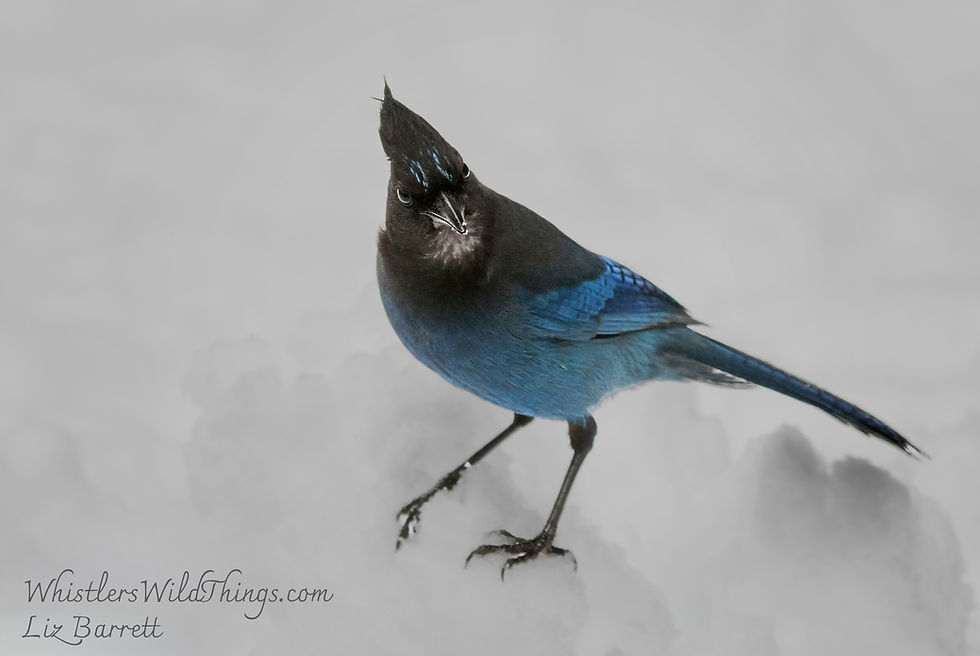
As a newcomer to Whistler, I participated in the Christmas Bird Count on December 14th, 2025. Rain was pouring like a carpet. We were on a civil mission to count and spot birds. My team met at Green Lake. “Unlikely we’ll see anything”, was the inauguration opinion. Yet, minutes later, one ventures: “Blue Jay!” “Wonderful, but it’s actually a Steller’s Jay”.
As I learned later, Blue Jays (Cyanocitta cristata) fly East of the Rocky Mountains, while Steller’s Jays (Cyanocitta stelleri) inhabit the West. But that’s not the only difference. Both the Blue Jay, with its white underparts, and the Steller’s Jay, its western counterpart, which is half blue half black, are sometimes referred as “Feathered thiefs”, because they steal food and eggs from other birds!
A name carries a story.
Later that day, we spotted a Kingfisher flying over the lake. It is unmistakable by its flight. “Belted Kingfisher” jolted the expert birder. Megaceryle alcyon’s female has a rusty belt crossing her belly. It is also known as Caribbean Kingfisher, because it migrates there in the winter months; which made me think of my boat, with her rusty belly, waiting for me in the Caribbeans. It seems that both of us chose to stay in the mountains this winter!
A name tells a story.
“Ducks!” I proudly shouted, as a dilettante would say. “Lesser Scaup! Bufflehead! Goldeneye! Hooded Merganser!” The birders said. The Lesser Scaup (Aythya affinis), is mostly smaller than the Greater Scaup (Aythya marila), and I won’t be surprised if it is pissed off to be called that way. The Bufflehead (Bucephala albeola) are famously known as among the world’s most punctual migrants. Does that mean they follow the clock more than global warming? Goldeneyes (Bucephala sp.), well, have golden eyes. And the Hooded Merganser (Lophodytes cucullatus) is a flamboyant diving duck with large fan-shaped crests they raise and lower at will, for courtship, and males croak instead of quack!
Naming acknowledges diversity and fantasy.
The bird that excited our ornithologists most was the American Dipper (Cinclus mexicanus), also known as the “Water Ouzel”. Dipper, because they dip up and down in a fast motion (60 times a minute), quite exciting! “Ouzel”, because they resemble the black bird, but they have white feathered eyelids, charming! And “water”, because they are North America’s only truly aquatic songbirds, chimeric, isn’t it? It becomes even more fantastic when we learn they have a third eyelid, transparent, like incorporated goggles!
Now, as a new mountaineer, I found a new passion: seeking birds along the trails, lakes, in the trees, and in the air. When I see an ave, I have to say something, to greet it, to acknowledge it, to bridge us, somehow. I could say “Hi bird.” Or invent a name. Or capture an image, a sound, and learn its name, its story, or call its name.
From my humble experience, it is like snorkeling, stargazing, and mushroom picking; the more I name the unique fish, the specific constellation, the peculiar mycelium fruit, the more I see them. It is as if naming were a magic wand that opens the realms of perception and connection!
So now, when I spot the neighborhood Jay in front of my window, I say, “Hi Steller, looking for an egg?”
Written by: Iulia DeAltaparte
This post about the power of naming is so interesting. Giving something a name gives it meaning and importance. I thought about that when I was working on a project and realized I needed to name my variables clearly to understand the logic. I used some computer science assignment help online to learn better coding practices. Good naming and clear thinking go hand in hand in any field. It showed me how self care matters. It helped me understand large projects better. Nice post . Your post make me smile.
I found this post interesting because it explores how naming shapes our understanding of nature and helps people notice and connect more deeply with the environment. A few years ago, I was reading about environmental communication and education, and I used Machine learning project assistance to help organize information from different sources. The idea that naming things can strengthen awareness shows how language plays an important role in learning, observation, and conservation efforts.
I came across the Skinny Shot (MIC+B12) info on Atlas Men's Health and found it quite interesting. It looks like these injections are designed to support energy, metabolism, and overall balance.
What stands out is how quick and simple the process seems. It’s something that can fit easily into a regular routine. Definitely worth checking out if you're curious about this type of support.
https://atlasmenshealth.com/skinnyshots
This was a really thoughtful post about the power of naming and it made me realise how something as simple as a name can actually shape how we see and understand the world around us. I didn’t really think about it before but naming things can make them feel more real and meaningful, whether its in nature, culture or even personal identity. It’s interesting how language can influence awareness too, like when we lose certain words we also kind of lose connection to what they represent, especially with nature and the environment . I sometimes get so caught up in my daily routine and studies that I don’t stop to reflect on ideas like this, even though they’re actually really…